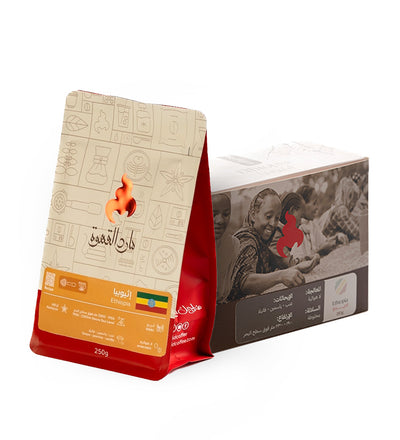
Farm: Kochere Debo Natural
Variety: Heirloom (Arabica)
Process: Natural
Altitude: 1850 - 2000 meters above sea level
Owner: Many smallholders
Town: Debo, Gedeo Zone
Region: Kochere, Yirgacheffe
Country: Ethiopia
Total Farm Size: Under 1 hectare

This exceptional product was processed, dried, and exported by Testi Coffee, a family business run by the Younis family, who are making a name for themselves in the Ethiopian specialty coffee market. For many years, Faysel Younis was the first person to be seriously involved in the coffee farming business. Faysel started working in 1990 but only supplied the local market. With the increased interest in specialty coffee in Ethiopia, Faysel found an opportunity for development, so he established Testi Coffee in 2009 as a coffee exporting company. Faysel surrounded himself with many professionals in the coffee world and also hired his nephew Adham, who grew up and studied in the United States, to help with marketing.

Today, Testi Coffee owns or manages 4 washing stations in Guji, Yirgacheffe, Sidamo, and Limu, which are considered among the most important coffee growing regions in Ethiopia.
Perhaps the name "Debo" is familiar; it is the name of the station where this coffee was processed. The station was established in 2000 and is managed in cooperation with Masreshu Sima. Testi monitors all quality standards and manages the station during and after the season. Coffee is brought to the stations from 750 to 800 small farms, to different collection stations. The station produces up to 5 containers per year.
The station is located in the Gedeo region. The region is surrounded by the Guji and Borena regions to the east, south, and west, as well as Sidamo to the north.

Yirgacheffe is part of the Sidamo region in southern Ethiopia, but the fame the region has gained from washed coffee has led to the region being divided into smaller areas. This green and high region is fertile land; most coffee is grown at an altitude of 2000 meters or higher. From a glance, the area looks like a forest, but in reality, it is a densely populated area with many villages in those forests. Approximately 26 organizations are active in the region, representing 43,794 farmers from 62,004 hectares of agriculture. Most coffee is processed by washing, but some is sun-dried.